
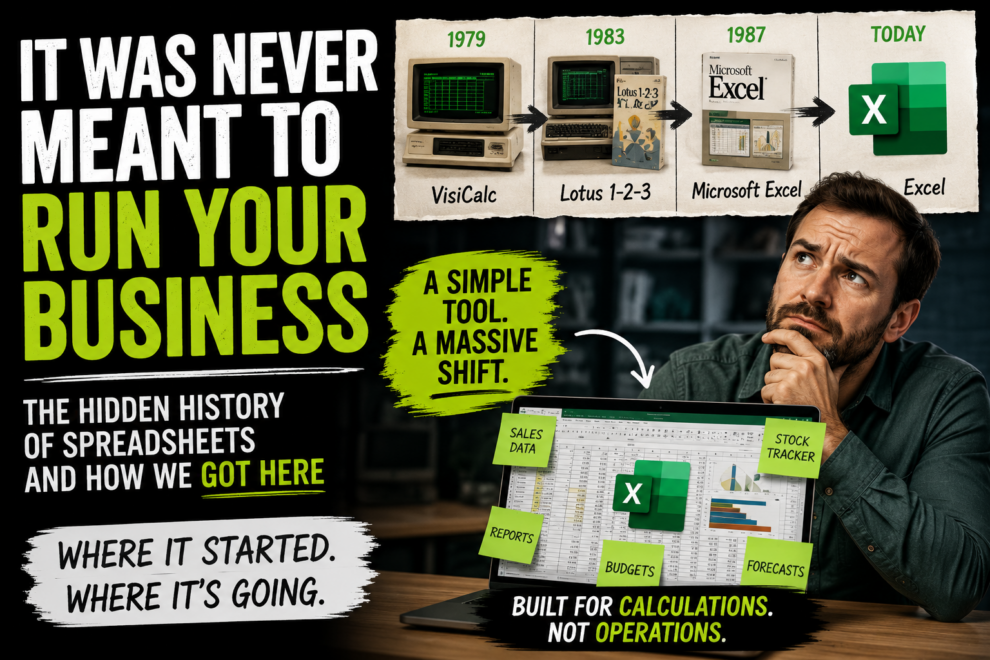
The Tool That Accidentally Took Over the Modern Business
Spreadsheets are everywhere.
They run finance departments, sales reports, stock control, forecasting models, HR tracking, quoting systems, and entire business operations.
But here’s the uncomfortable truth most businesses never stop to consider:
Spreadsheets were never designed to run businesses.
They were designed to help accountants and analysts perform calculations on a digital grid.
So how did something so simple end up running so much of the modern business world?
To understand that, we need to go back to where it all started.
Where Spreadsheets Began
The first real breakthrough came in 1979 with a program called VisiCalc, created by Dan Bricklin and Bob Frankston.
VisiCalc is widely recognised as the first spreadsheet program.
It ran on early personal computers like the Apple II and was revolutionary at the time. For the first time, users could:
- Enter numbers into a grid
- Perform calculations automatically
- See instant updates when values changed
Before this, everything was done manually on paper or calculators.
VisiCalc wasn’t designed to run companies.
It was designed to save time on calculations.
But it changed everything.
Then Came Lotus 1-2-3
In the 1980s, Lotus 1-2-3 took the concept further.
It combined:
- Calculations
- Basic data management
- Early charting tools
At this point, spreadsheets started moving beyond accounting and into general business use.
Still, the intention was simple:
Help people analyse numbers faster.
Not run entire operational systems.
The Microsoft Excel Era
Then came the game-changer: Microsoft Excel, released in the late 1980s.
Excel became the dominant spreadsheet tool globally because:
- It was bundled into Microsoft Office
- It was easy to learn
- It was flexible
- It worked on almost every business computer
Over time, Excel became more powerful:
- Formulas
- Pivot tables
- Macros
- Data connections
- Automation features
And this is where things started to shift.
Businesses stopped using spreadsheets as tools.
They started using them as systems.
So… Were Spreadsheets Ever Meant to Do This?
The short answer is no.
Spreadsheets were designed for:
- Calculations
- Analysis
- Modelling
- Reporting snapshots
They were never designed for:
- Multi-user collaboration at scale
- Live operational workflows
- Version control across teams
- System-wide business processes
- Real-time centralised data
Yet today, many businesses rely on spreadsheets as if they are full operational platforms.
And that mismatch is where the problems begin.
The Problem With Turning a Tool Into a System
A spreadsheet works brilliantly when:
- One person owns it
- The dataset is small
- The logic is simple
- The purpose is short-term analysis
It breaks down when:
- Multiple people edit it
- It becomes mission-critical
- It replaces proper software systems
- It grows over time without structure
At that point, spreadsheets stop being a tool and become an unmanaged system.
And unmanaged systems create risk.
Why Businesses Still Use Them Anyway
Despite everything, spreadsheets remain deeply embedded in business operations for three simple reasons:
1. They’re familiar
Everyone knows Excel. Training is minimal.
2. They’re flexible
You can build almost anything… at least at first.
3. They started small
Most spreadsheet systems begin as “just a quick tracker” and slowly evolve into something critical.
That slow evolution is exactly what makes them dangerous.
The Modern Reality: Spreadsheets Are Running Businesses They Were Never Designed For
Fast forward to today, and spreadsheets are often doing jobs they were never intended to handle:
- Acting as CRMs
- Managing production schedules
- Tracking stock and logistics
- Running quoting systems
- Handling financial forecasting
- Storing customer data
And because of that, businesses now face:
- Fragmented data
- Human error
- Lack of visibility
- Multiple versions of truth
- Heavy reliance on individuals
- Slow decision-making
The Shift That’s Happening Now
This is why businesses are starting to move away from spreadsheets and toward bespoke systems.
Not because spreadsheets are “bad”.
But because business has outgrown them.
Modern companies are now asking a different question:
Instead of “Can we build this in Excel?”
They are asking:
“Why are we still trying to run this in Excel at all?”
Where Sixfields Software Fits In
At Sixfields Software, we build systems that replace spreadsheet chaos with structured, reliable software built around how businesses actually operate.
Not around a grid of cells.
Not around manual updates.
Not around version confusion.
But around real workflows, real data, and real business processes.
Because spreadsheets changed the world once.
But they were never meant to run it.