
Death by a Thousand Tiny Tasks
Business owners tend to look for big problems.
A lost customer.
A failed project.
A costly mistake.
But the real damage in most businesses rarely comes from one big event.
It comes from hundreds of small interruptions that never feel important enough to fix.
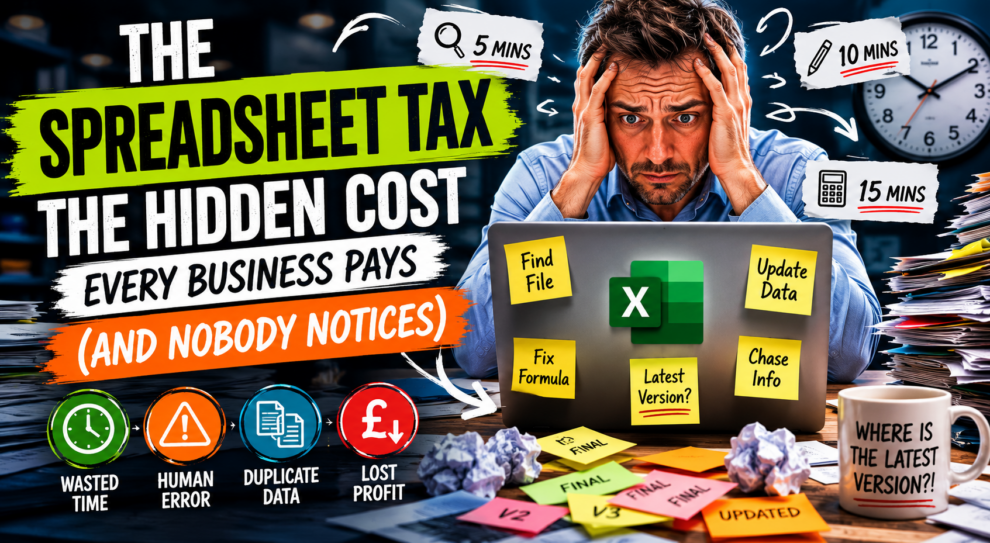
Five minutes searching for a file.
Ten minutes updating a spreadsheet.
Fifteen minutes correcting a formula.
On their own, they’re nothing.
But they don’t happen on their own.
They happen every day. Across every team. In every system.
And that’s where the cost builds.
Not in hours lost once, but in hours lost constantly.
“Can You Just Update the Spreadsheet?”
It sounds simple.
A quick change.
A few numbers adjusted.
A report sent over.
Five minutes of work.
Except it isn’t five minutes.
It’s five minutes repeated across multiple people, multiple departments, multiple versions of the same spreadsheet.
And then repeated again tomorrow.
And the day after that.
Until what looked harmless becomes hundreds of hours quietly disappearing.
Not because people aren’t capable.
But because the business is relying on systems that were never designed to scale it.
The Biggest Cost Isn’t The Spreadsheet
Most spreadsheets are free.
Excel comes with Microsoft Office.
Google Sheets costs next to nothing.
The file itself isn’t expensive.
What’s expensive is everything that surrounds it.
Every business owner has heard these phrases:
“Where did I save that?”
“I think that’s the latest version.”
“Can somebody send me the spreadsheet?”
“Who changed these figures?”
“That formula doesn’t seem right.”
“I swear it worked yesterday.”
None of these problems sound serious.
Until they’re happening every day.
Death By A Thousand Updates
Spreadsheets don’t usually fail dramatically.
They slowly drain time from the business.
An employee updates one sheet.
Then copies information into another.
Then emails it to a colleague.
Who updates their version.
Who sends it to a manager.
Who exports it into a report.
Nobody notices the waste because each step only takes a few minutes.
But multiply those minutes across weeks, months and years and the cost becomes staggering.
The Five Ways Spreadsheets Steal Time
1. Finding The Right File
The spreadsheet exists.
Everyone knows it exists.
The challenge is finding it.
Is it on the shared drive?
In an email?
On Dave’s desktop?
In OneDrive?
In the Downloads folder?
Many businesses spend more time searching for information than actually using it.
2. Updating Information Multiple Times
One customer changes their details.
Now someone updates:
- The spreadsheet
- The CRM
- The quoting system
- The job tracker
The same information gets entered repeatedly because none of the systems talk to each other.
It’s repetitive.
It’s frustrating.
And it’s completely avoidable.
3. Fixing Human Errors
Spreadsheets rely on people.
People make mistakes.
A formula gets deleted.
A cell gets overwritten.
A row gets moved.
A number gets typed incorrectly.
Then someone spends an hour trying to work out why the report suddenly looks wrong.
4. Creating Reports Nobody Enjoys Making
Friday afternoon.
Management wants numbers.
Someone starts copying data from one spreadsheet into another.
Formatting begins.
Graphs are created.
Figures are checked.
The report finally gets sent.
Then the following Friday the entire process starts again.
5. Rebuilding Work That Already Existed
This is perhaps the most frustrating one.
A file gets corrupted.
An employee leaves.
A spreadsheet disappears.
A critical formula breaks.
Suddenly work that already existed has to be recreated from scratch.
Time gets spent rebuilding instead of improving.
What Does This Actually Cost?
Let’s be conservative.
Imagine five office staff lose just three hours per week dealing with spreadsheet administration.
That’s:
- Finding files
- Updating records
- Correcting mistakes
- Chasing information
- Producing reports
Three hours doesn’t sound like much.
Until you calculate it.
5 employees × 3 hours per week × 48 working weeks.
That’s 720 hours every year.
Nearly 18 full working weeks.
Gone.
Not generating revenue.
Not serving customers.
Not growing the business.
Just maintaining spreadsheets.
Why Most Businesses Never Spot The Problem
Because nobody complains.
The tasks become normal.
The inefficiencies become routine.
People simply accept that finding files, fixing formulas and updating spreadsheets is part of the job.
But normal doesn’t mean efficient.
And just because something has always been done that way doesn’t mean it should continue.
The Question Every Business Owner Should Ask
If somebody followed your team around for a week with a stopwatch, how much time would they spend:
- Searching for spreadsheets?
- Updating spreadsheets?
- Correcting spreadsheets?
- Reporting from spreadsheets?
- Chasing spreadsheet information?
Most business owners don’t know the answer.
Most would be shocked if they did.
There Comes A Point Where A Spreadsheet Stops Being A Tool
Spreadsheets are excellent for:
- Analysis
- Forecasting
- One-off calculations
- Data modelling
That’s what they were built for.
What they weren’t built for is running daily business operations.
Yet thousands of businesses still rely on spreadsheets to manage:
- Jobs
- Customers
- Scheduling
- Reporting
- Production
- Operations
At that point, the spreadsheet has stopped being a tool.
It’s become a system.
And systems should be designed properly.
There Is A Better Way
At Sixfields Software, we help businesses replace spreadsheet-heavy processes with bespoke software built around the way they already work.
No hunting for files.
No version confusion.
No duplicated data.
No manual reporting.
Just one system, one source of truth, and a lot less wasted time.
Because every business pays the spreadsheet tax.
The question is how much yours is paying.