
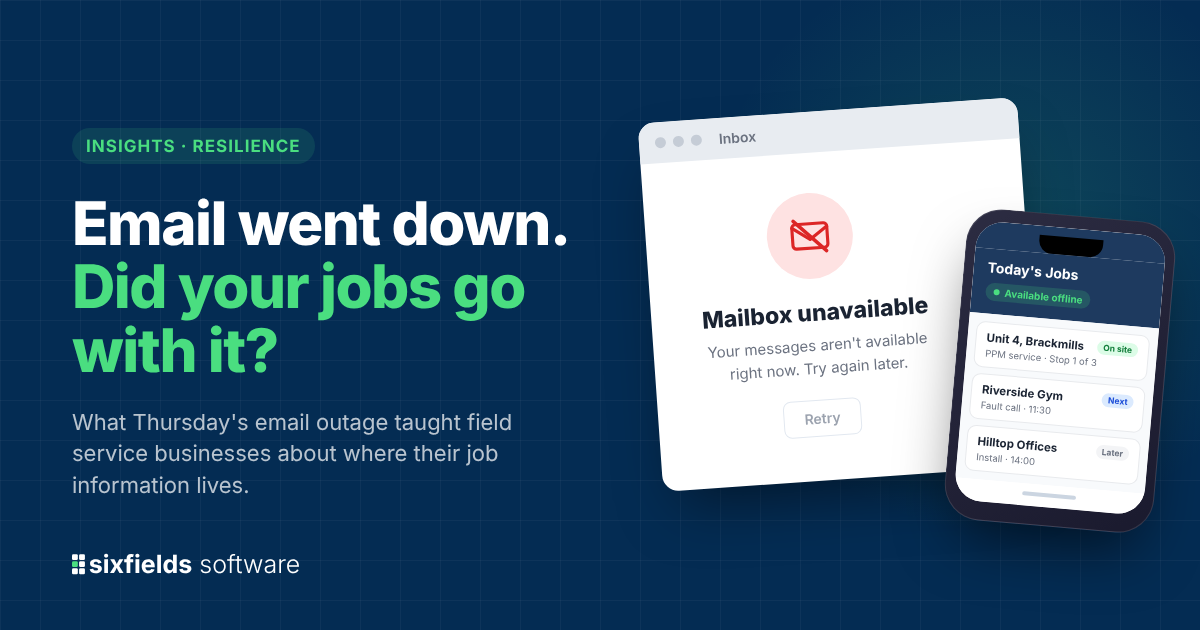
On Thursday 12 November, Microsoft 365 had one of its biggest outages in years. Outlook stopped connecting to mailboxes, and Teams, SharePoint and Copilot were also affected. Microsoft said a number of its servers had become unexpectedly unavailable, which overloaded the ones that were left. Recovery went on into the next day, with email still catching up more than 23 hours after the problems began.
To be clear about what it wasn’t: Microsoft said it found no sign of a hack or cyber attack. It was an infrastructure failure, the kind that happens to every large system sooner or later. Microsoft also extended how long it holds undelivered email to 48 hours, so most delayed messages should have arrived once things recovered.
So this isn’t a post about Microsoft being bad, or about leaving it. Microsoft 365 is a solid, secure platform, and for most small businesses it’s still the right choice for email. This post is about what the outage showed many field service businesses about themselves.
What Thursday looked like on the ground
Picture a normal day for a business with a handful of engineers out on the road.
The engineer’s first job is at a site they’ve never been to. The address, access code and site contact are in an email from the office. Outlook won’t load.
The second job is a follow-up visit. The notes from last time, the parts that were ordered and the customer’s photos are attached to an email thread. That won’t load either.
Back at the office, someone is trying to send out tomorrow’s schedule. It’s in a spreadsheet attached to an email, and the shared folder it lives in is on SharePoint. Teams is struggling, so they start ringing round engineers one by one.
None of this is Microsoft’s fault. Email just ended up doing a job it was never designed for.
The real problem: one tool doing every job
Email is brilliant at what it was built for, which is sending messages between people. In many small businesses it has slowly become something else as well: the job system, the filing cabinet, the schedule, the photo library and the customer record, all at once.
That works until the day it doesn’t. When one tool holds everything, one outage stops everything. It doesn’t matter whether the cause is a Microsoft server, a broadband fault at the office or a forgotten password. The effect is the same.
The fix isn’t to find a tool that never goes down, because none exists. The fix is to stop putting everything in one place.
Four practical steps for any field service business
None of these need new software, and most can be done this week.
1. Keep job information out of the inbox. Email is fine for telling someone a job exists. The job itself, including the address, notes, history, photos and sign-off, should live somewhere built for it. That could be a job management system, or even a well-organised shared folder. The point is that it’s separate from email, so if one goes down you still have the other.
2. Make sure engineers have today’s jobs on their phone, offline. If an engineer needs a working internet connection and a working email service just to find out where they’re going, that’s a weak point. At the very least, they should have the day’s addresses, contacts and job details saved on their phone before they leave in the morning.
3. Have a second way to reach the team. If Teams is your main channel, make sure everyone also has a phone number, a text group or a WhatsApp group as a backup. You don’t need to use it day to day, but you need it in place before the day you do.
4. Know who to call, and write it down. When something breaks, who checks whether the problem is you or the provider? Who tells the engineers? Who tells customers if visits are running late? Write down a simple plan of a few lines, and keep a copy that doesn’t live in your email.
Where Sixfields fits
We built Sixfields because we’ve seen what happens when a field business runs on email and spreadsheets. In Sixfields, every job sits on a single record with its address, notes, photos, history and sign-off, separate from your email. Engineers get their jobs in an app on their phone that works offline, and anything they record on site syncs once they have signal again.
It doesn’t mean nothing can ever go wrong. Every system, ours included, can have a bad day, and anyone who promises otherwise isn’t being straight with you. What it does mean is that a problem with your email doesn’t become a problem with your jobs.
The takeaway
Thursday’s outage will be fixed and forgotten within a week or two. The thing worth remembering is how much of the day stopped because the inbox did.
You don’t have to leave Microsoft. Just make sure your business doesn’t depend on any single tool working all day, every day.
If you’d like to talk through how your jobs are run today, and where the weak points are, get in touch. We’ll tell you straight whether Sixfields is the right fit.
The facts in the post come from the BleepingComputer report. Microsoft hasn’t published the final root cause yet, so the post says only what it has confirmed so far. If you want a source link in the post itself, add it after “biggest outages in years”. It’s worth publishing within the next few days while people still remember the outage.