
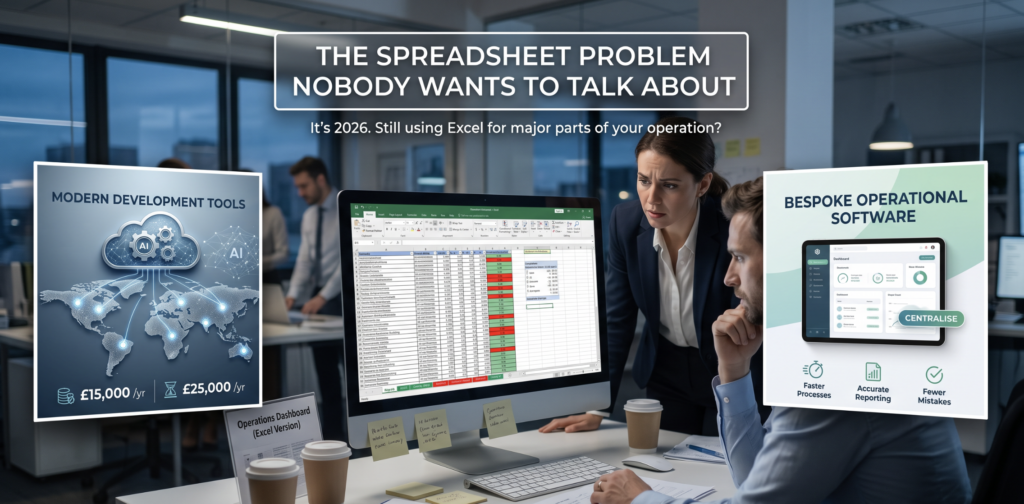
The Spreadsheet Problem Nobody Wants to Talk About
It’s 2026.
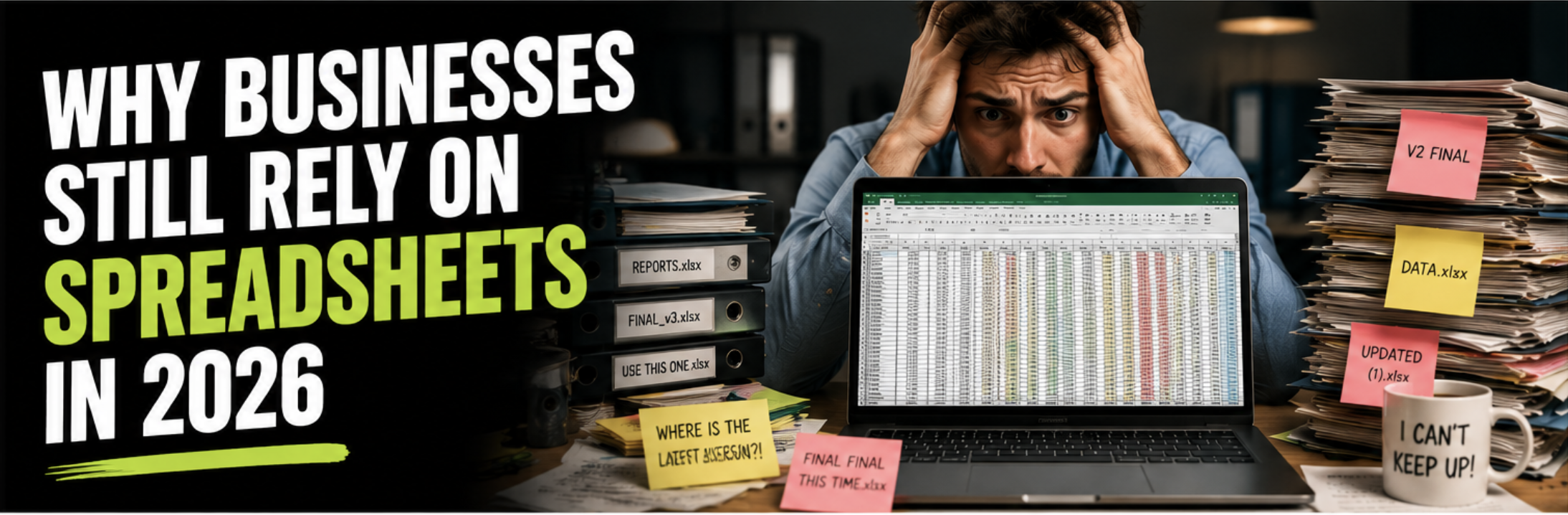
Artificial intelligence is everywhere. Businesses are more connected than ever. Yet thousands of companies across the UK still run major parts of their operation using spreadsheets.
Stock control. Quotes. Production schedules. Job tracking. Customer information. Reporting. Margins. Staff processes.
All sitting inside Excel files inside a folder, inside another folder.
Some businesses even rely on spreadsheets that were originally built 5 or 10 years ago by someone who no longer works there.
The surprising truth is this:
Most businesses are not using spreadsheets because they want to.
They’re using them because the software they bought never truly fitted the way they operate.
The False Promise of “One Size Fits All” Software
For years, businesses were told they needed large CRM or ERP systems to become more efficient.
And on paper, those systems sound perfect.
They promise:
- Automation
- Centralised data
- Better reporting
- Improved efficiency
- Scalability
But reality is often very different.
Most off the shelf software is designed to work for “everyone”.
Which usually means it works perfectly for almost nobody.
Every business has its own way of operating:
- Different workflows
- Different approval processes
- Different terminology
- Different pricing structures
- Different customer journeys
- Different operational challenges
Generic systems force businesses to adapt themselves around rigid software structures.
Not the other way around.
That’s where the cracks begin.
Why Businesses End Up Back in Excel
This is what typically happens:
A business invests heavily into CRM or ERP software.
The system handles around 60 – 70% of what they need.
Then the workarounds begin.
Spreadsheets are created to fill the gaps.
Another piece of software gets added.
Then another.
Before long, the business is operating with:
- A CRM system
- Accounting software
- Scheduling software
- Spreadsheet reporting
- A quoting tool
- Shared drives
- Email-based processes
Most businesses today are juggling between 3 and 6 different systems just to keep operations moving.
The result?
- Duplicate data
- Human error
- Wasted hours
- Poor visibility
- Frustrated staff
- Lost profit
And perhaps worst of all, management teams stop trusting their own data.
Businesses Are Tired of “Making It Work”
For years, companies accepted this as normal.
Not anymore.
Businesses are beginning to realise something important:
Software should adapt to the business.
The business should not have to adapt to the software.
That shift in thinking is exactly why bespoke software is growing rapidly across industries.
Bespoke Software Has Changed
There’s an outdated belief that custom software is only for massive corporations with £250,000 budgets.
That might have been true 15 years ago.
It isn’t true now.
Modern development tools, cloud infrastructure, automation platforms, and AI-assisted development have changed the landscape completely.
Today, many businesses can implement custom operational software for roughly:
- £12,000
- £15,000
- £25,000 per year
Often replacing multiple subscriptions, duplicated processes, spreadsheet management, and manual administration.
For many companies, the return on investment becomes obvious very quickly.
The Real Reason Businesses Are Moving Towards Bespoke Systems
This isn’t just about technology.
It’s about control.
Businesses want:
- One central system
- Faster processes
- Accurate reporting
- Reduced admin
- Better visibility
- Fewer mistakes
- Higher margins
- Less dependency on disconnected software
But there’s another reason that matters just as much.
Business owners are tired of operational chaos.
When information lives across emails, spreadsheets, and multiple platforms, growth becomes difficult.
Everything takes longer.
Mistakes increase.
Staff waste time.
Managers lose visibility.
Bespoke software solves this by bringing operations together into a single system built specifically around how the company actually works.
Not how a software vendor thinks they should work.
One System. Built Around Your Business.
At Sixfields Software, we believe operational software should fit your business like a tailored suit.
Not a compromise.
That means:
- Removing spreadsheet dependency
- Centralising operations
- Automating repetitive tasks
- Connecting departments together
- Protecting margins through efficiency
- Saving time across the business
And perhaps most importantly — giving businesses clarity and control again.
The future of business software is not generic.
It’s bespoke.